One of the first big questions in planning the lap looked simple on paper and turned into a full‑blown saga in real life:
What’s towing the Ultimate?
We already had the 2019 Holden Trailblazer LTZ — 2.8‑litre diesel, seven seats, 138,000 km, and a personality I know better than some relatives. Solid. Capable. Familiar. But was it the car for a year on the road, dragging a camper across whatever Australia decides to throw at us?
We crunched the numbers. Then crunched them again. Then crunched them so many times the calculator started giving me attitude. Every time we looked at buying a new 4WD, the maths just didn’t stack up — not for the budget, not for the timeline, not for my sanity.
So the verdict landed:
Yep, the Trailblazer is coming.
But… she needed a little help.
And by “a little,” I mean a list that grew faster than a Bunnings sausage‑sizzle queue:
- 2‑inch lift kit
- Bull bar + spotties
- Long‑range tank
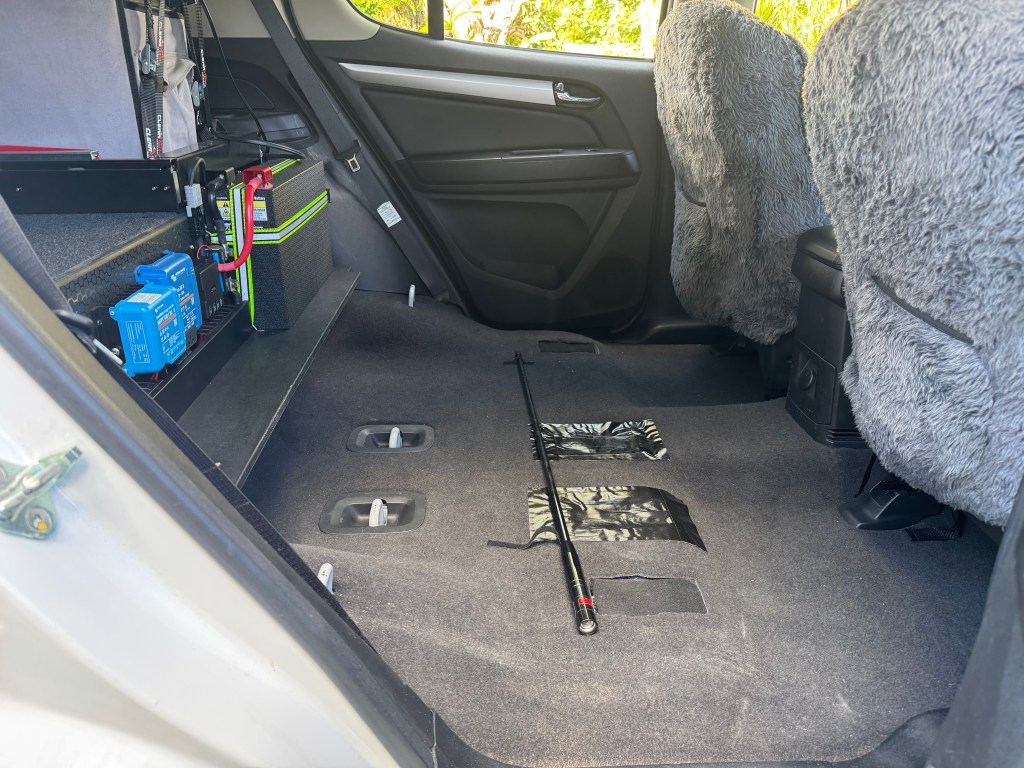
- Rear seats out → drawers + 40L Engel slide
- UHF
- New tyres
- 200Ah lithium + charging points
- Replace the torque converter
- Middle seats out → more storage
The torque‑converter gremlins were the final nudge. If we were committing to this car, we were committing properly.
The hunt for the mythical one‑stop shop
I rang Brisbane. Then the southside. Then the Sunny Coast. Everyone could do some of the work, but no one could do all of it. The logistics alone were turning into a part‑time job, and the quotes were creeping north of $25k.
Then, while we were down looking at the Ultimate, the 4WD centre casually dropped:
“Yeah, we can do the lot.”
So in the same breath we signed up for the Ultimate, we also signed up for $20k worth of Trailblazer upgrades. Efficient. Terrifying. Very us.
The Port Macquarie shuffle
Before the drawers could go in, the back seats had to come out. This was both harder and easier than expected — a theme of this whole adventure.
Seats out, I drove the Trailblazer 5.5 hours from Brisbane to Port Macquarie, dropped it off, and flew home. Couple of weeks later, flew back down, picked it up at 4:30 pm, and drove straight back to Brisbane that night.
Big day. Big coffee bill.
The only thing they didn’t do was the 200Ah battery — I’d already lined that up with a local Brisbane installer.
By November 2025, the battery, UHF, and spotties were in. The car was ready.
Or so we thought.
The GVM reality check
Something told me to weigh the car. I wish that “something” had spoken up earlier.
- Before upgrades: 2300 kg
- After upgrades: 2640 kg
- GVM: 2840 kg
- Wife not included: noted for future diplomacy
That margin was way too tight.
Then came the questions I should have asked months earlier:
- Is the Ironman lift kit GVM‑compatible? No.
- Do I need a mod plate for the long‑range tank in Queensland? Yes. Of course I do.
Thankfully the fuel‑tank certificate is only a couple hundred bucks — annoying, but survivable.
Removing the middle seats would claw back some weight. So the plan became:
finish mods → weigh again → pray we don’t need a full GVM upgrade.
Middle seats out — the Davo engineering hour
The middle seats came out next. Easier and harder than the back seats, and a lot heavier. The trick is removing the bolts in the right order — fold the seats at the wrong time and you’re suddenly wrestling a metal octopus. Bit of cursing, a crowbar, and some stubbornness fixed the problem.
Unclipping the seat‑belt warning wires?
Tiny clips. Big frustration. Lots of Googling.
But once they were out — so much space.
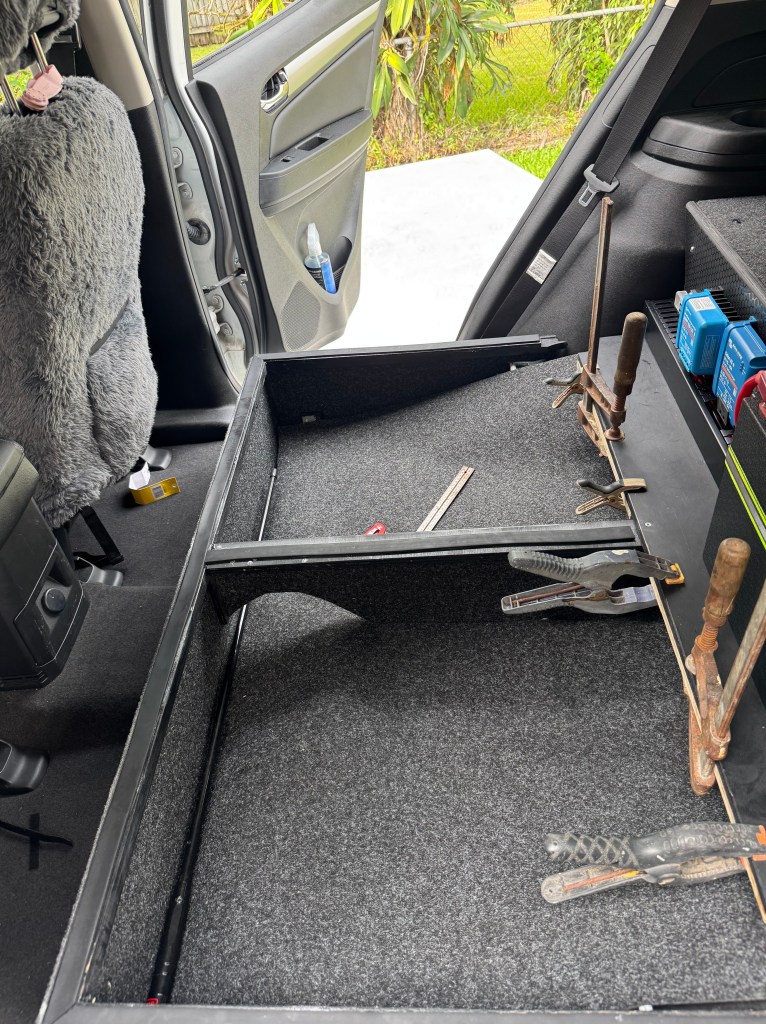
The back‑seat install left a 150 mm shelf about 180 mm off the floor, growing to nearly 250 mm as you move forward. Perfect height for storage. Next question: how much space to leave behind the front seats? Needed enough for seat movement and those rare “caught in the middle of nowhere, need a nap” moments.
The magic 250 mm came through again.
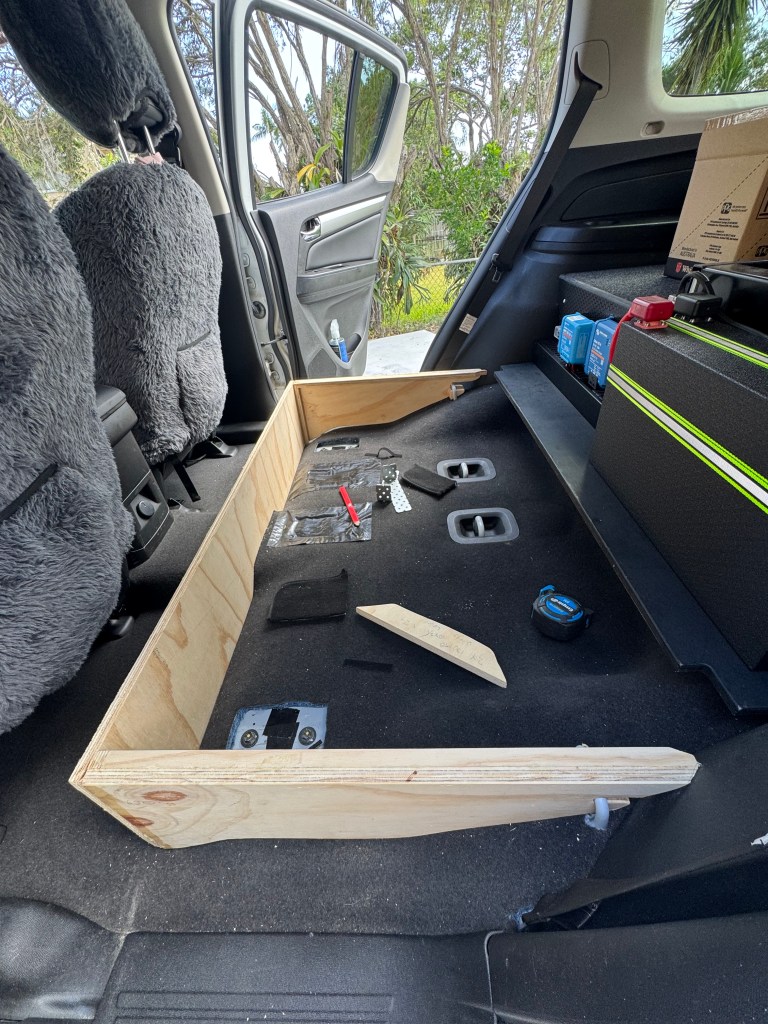
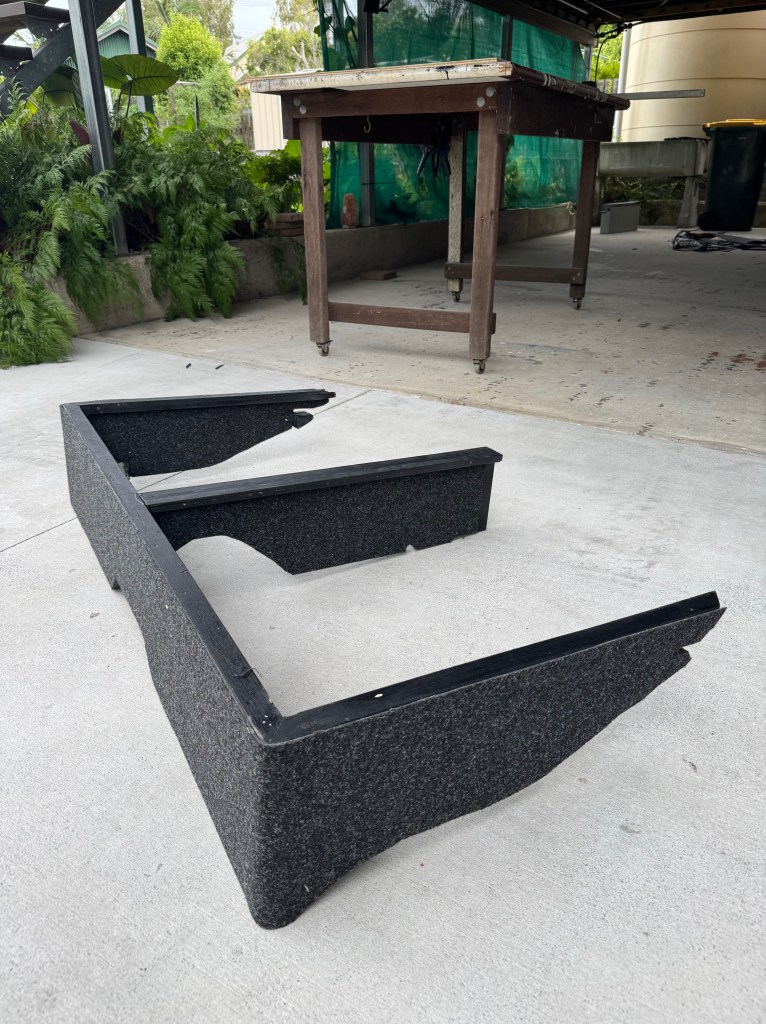
Then came the build.
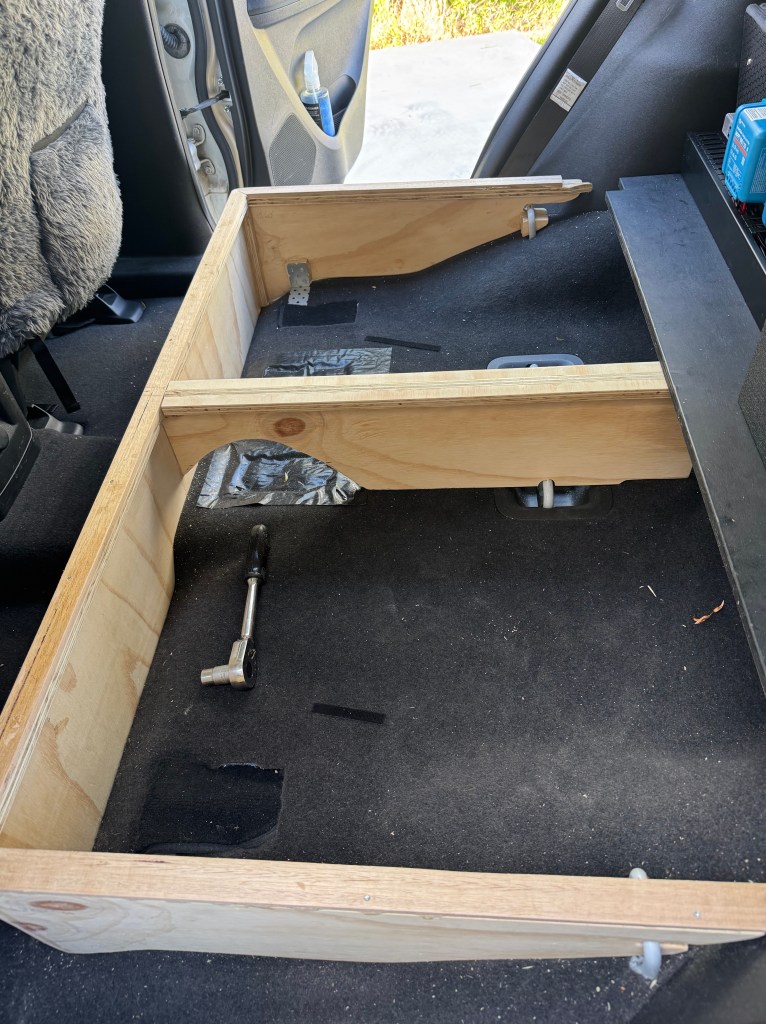
15 mm lightweight ply — perfect.
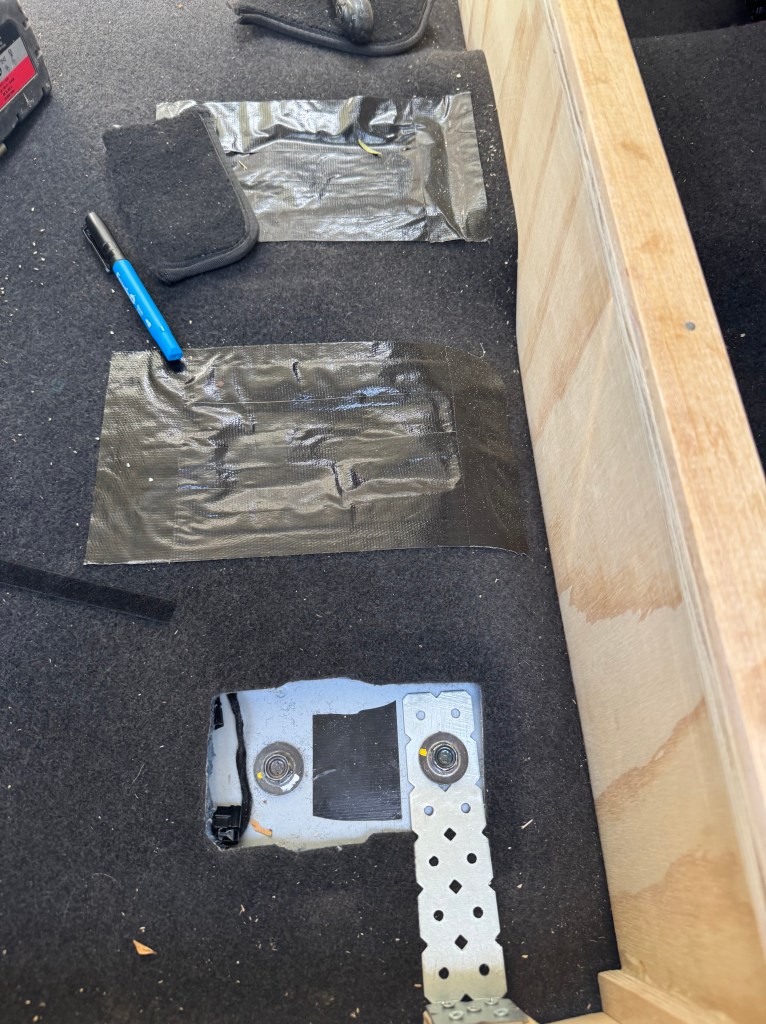
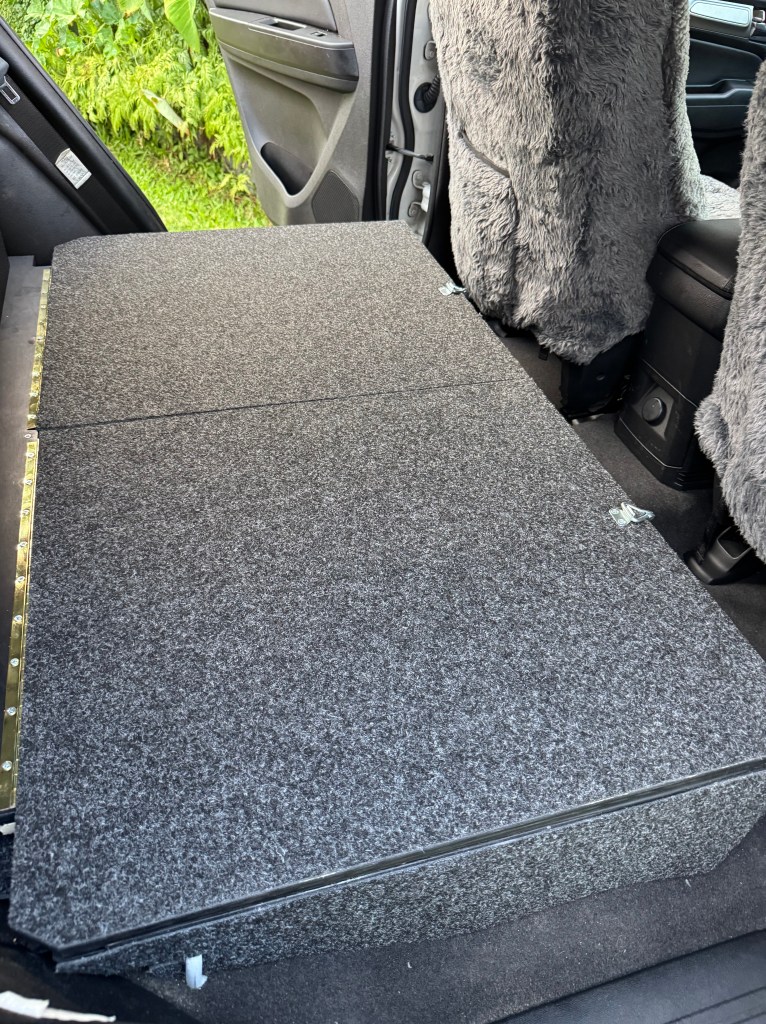
The floor wasn’t flat — of course it wasn’t — so I templated it with scrap ply. Two lids meant a centre rail. Fixing it to the car? Used the rear seat hook and the front seat bolts. Solid as.
Once installed, I realised I was 10 mm too low compared to the existing setup. Classic.
Solution: 8 mm cover + 5 mm stick‑on rubber.
Result: lids close perfectly, no rattles, looks intentional.
Painted it with leftover black chalkboard paint, stuck on carpet, and honestly — it looks bought, not built. You can judge from the photos.
Now we’ve got hidden storage, a floating flat floor, and space for boxes, buckets, or whatever else we dream up. Just need to add anchor points.
Where we landed
The Trailblazer might not be the obvious choice, but it’s ours — and with the upgrades, it’s capable, comfortable, and ready for the lap.
Well… almost ready. There’s always one more thing to check, one more tweak, one more “why didn’t anyone tell me this earlier”.
But that’s part of the adventure.
And honestly — I’m starting to enjoy the chaos.